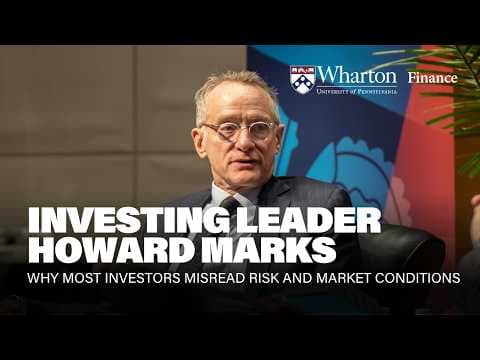
Howard Marks on How to Think About Investment Risk
True investment skill is achieving returns while taking less-than-proportionate risk.
30-second summary
Legendary investor Howard Marks reframes investment risk, arguing that true skill lies in achieving asymmetrical returns—capturing upside while limiting downside. He distinguishes real risk (the probability of permanent capital loss) from academic measures like volatility, emphasizing that risk is unquantifiable, behavioral, and heavily dependent on purchase price rather than asset quality. To navigate uncertainty, investors must maintain continuous risk control rather than trying to avoid risk entirely.
Core concepts
Asymmetry Defines True Investment Skill
Achieving investment return when the market rises is easy. True investor skill (alpha) is demonstrated through asymmetry: capturing most of the upside in good times while suffering significantly less loss than the market during bad times.
Risk Is Not Volatility or Asset Quality
Academia defines risk as volatility (standard deviation) because volatility is easily quantifiable. However, actual investment risk is the probability of permanent capital loss. Furthermore, risk is not determined by asset quality alone; high-quality assets can be extremely risky if overpriced, whereas low-quality assets can be safe if purchased at a sufficient discount.
The Nifty Fifty vs. High-Yield Bonds
In 1969, Citicorp invested heavily in the 'Nifty Fifty,' the fifty highest-quality, fastest-growing companies in America that seemed impossible to fail. Investors bought them regardless of valuation, but over the next five years, holding those stocks resulted in losing nearly all capital due to extreme overpricing. Shortly after, Marks transitioned to managing high-yield bonds issued by America's lowest-rated public companies. By purchasing these low-quality assets at deep discounts, he achieved safe, dependable returns because the cheap purchase price compensated for the credit risk.
Risk Is Behavioral and Counter-Intuitive
Risk does not reside primarily in financial assets or instruments, but in the psychological behavior of market participants. When investors collectively believe there is no risk, they bid up prices and take reckless chances, creating maximum danger; conversely, widespread fear and risk aversion make the market far safer.
Knowing Probabilities Does Not Predict Outcomes
Understanding a probability distribution does not reveal what specific event will happen next. Investors live in a single realized sample of events, not the full theoretical universe, meaning low-probability downside risks regularly materialize and expected-value calculations can be misleading or dangerous.
The Risk-Return Relationship Means Wider Outcomes, Not Guaranteed Gains
The popular idea that taking higher risk produces higher returns is logically flawed—if risky assets reliably returned more money, they would not be risky. Moving to higher risk levels increases expected return alongside a wider dispersion of possible outcomes and a greater severity of potential loss.
Risk Control Must Be Continuous, Not Sporadic
Because market downturns are unpredictable, risk control must be maintained constantly like car insurance rather than turned on and off. The value of risk management is often invisible during bull markets and is only revealed when negative economic conditions test portfolio resilience.
5-minute action
Conduct a Pre-Mortem on Your Investment Position
- Select one current asset or portfolio position you hold or are planning to buy.
- Imagine it is three years in the future and the position has suffered a severe 40% loss.
- Write down 2-3 specific conditions, market shifts, or behavioral blind spots that could cause this outcome, regardless of how unlikely they seem today.
ExampleIf evaluating a high-growth tech stock, imagine an environment where rising interest rates compress valuation multiples while a new competitor erodes profit margins, exposing hidden vulnerability.
Timer